
True Summer vs Soft Summer: The Saturation Difference
Direct Answer — True Summer vs Soft Summer
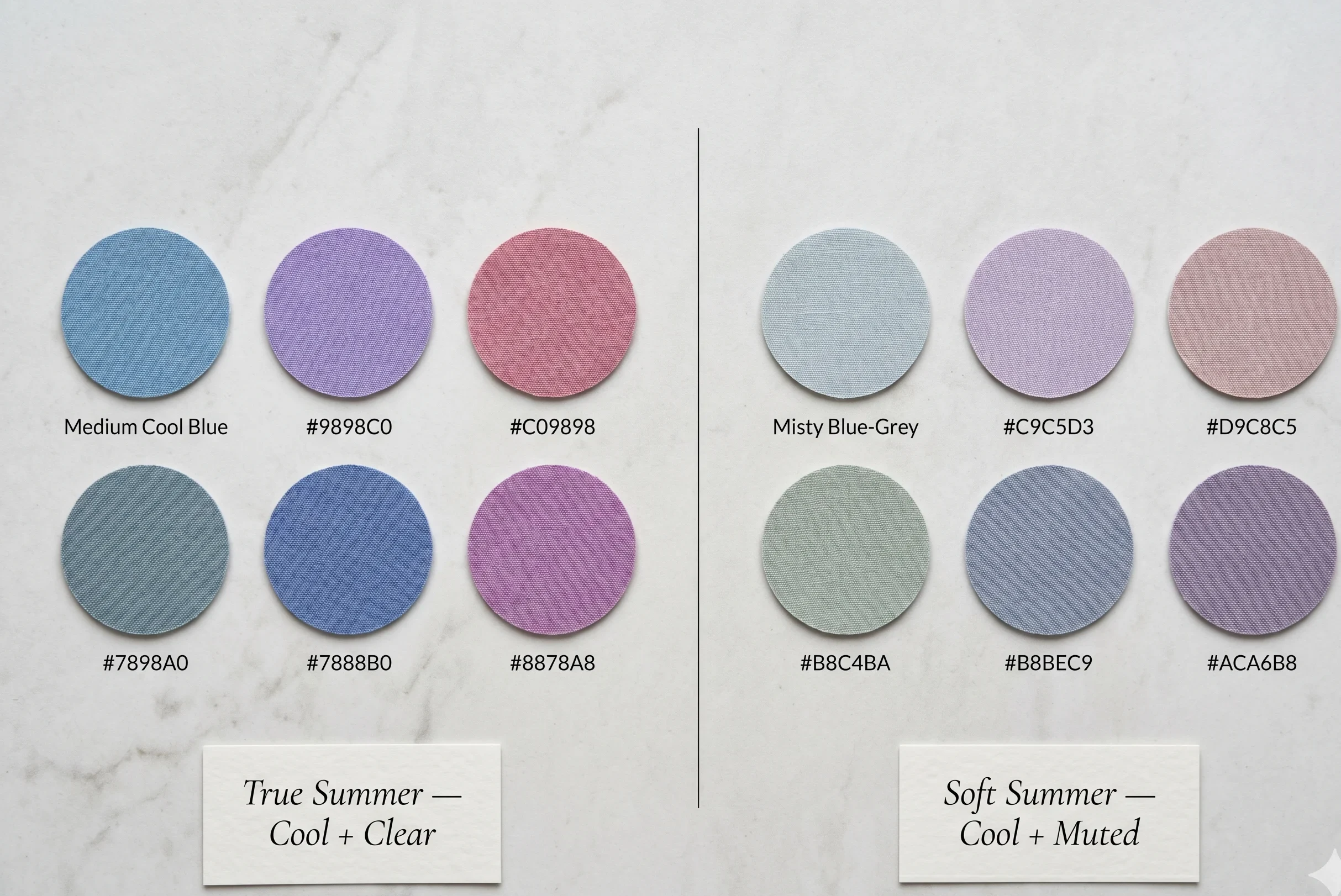
One word separates True Summer from Soft Summer: saturation. Both seasons are cool-toned. Both avoid warm colours. But True Summer can wear slightly clearer, more defined cool colours — medium saturation. Soft Summer needs everything significantly greyed-down and muted — low saturation. True Summer is a crisp overcast sky. Soft Summer is the same sky seen through sea mist. Same cool temperature. Different clarity level.
What They Share First — The Common Ground
True Summer and Soft Summer are the most commonly confused colour seasons — and understandably so. They share the same thermal direction, the same family, and several physical characteristics. Understanding what they have in common before addressing the difference helps you use the right framework for comparison.
Cool undertone
Medium saturation
Medium contrast
Crisp clarity
The purest expression of the Summer family. Cool-toned throughout, with a clarity and definition that makes colours read as distinctly “themselves” rather than blended or ambiguous.
Cool undertone
Low saturation
Low-medium contrast
Greyed quality
The muted sub-season of the Summer family. Cool-toned throughout, but with a significant grey modifier that reduces saturation to a blended, dusty, slightly ambiguous quality.
What both seasons share: cool thermal undertone, discomfort with warm colours (orange, gold, caramel, terracotta), an instinct toward blues and mauves, and difficulty with very high contrast pairings. They are seasonal siblings — the distance between them is smaller than the distance between either of them and Soft Autumn or Bright Spring.
Entity Relationship — Where These Seasons Sit
True Summer IS the central expression OF the Summer season family IN the 16-season colour framework. Soft Summer IS a sub-season OF the Summer family, sitting at the junction where Summer meets Soft Autumn (sharing Summer’s cool direction and Soft Autumn’s muted saturation). Both belong to the broader Summer family, which also includes Light Summer and Warm Summer in the 16-season framework.
The One Difference — Saturation Explained
Saturation — also called chroma in the Munsell colour system — is the measurement of colour intensity. At high saturation (high chroma), a colour is vivid and fully itself. At low saturation (low chroma), a colour has been greyed-down, muted, or blended toward neutral.
The Single Defining Difference Between True Summer and Soft Summer
Same cool temperature · Same hue family · Different saturation level
True Summer Blue True Summer Blue
Clearly Blue
Cool, medium saturation
Munsell: 5PB 5/6
Soft Summer Blue Soft Summer Blue
Grey-Blue Ambiguity
Cool, low saturation
Munsell: 5PB 7/2
Both swatches above are cool blue. Both are in the correct thermal direction for both seasons. The only difference: the True Summer blue has been reduced in saturation by ~4 chroma units compared to the Soft Summer blue. That single change is the entire distinction between these two seasons.
The Nature Analogy — True Summer vs Soft Summer
Picture a coastal scene on a clear overcast August day. The sea is steel-blue with visible definition. The sky is pale grey-blue with a clear quality — you can read the depth of the colour without effort. The stones on the beach are grey-blue and clearly grey. That is True Summer: cool, defined, each element clearly itself.
Now picture the same scene at dusk with a light sea mist rolling in. The steel-blue sea is now grey-blue-mist. The sky has a lavender-grey quality you could not quite name. The stones blend into the sand. The colours are still cool — but they have lost their definition and acquired an ambiguous, blended softness. That is Soft Summer: same cool direction, but wrapped in a grey veil that merges and softens everything.If you are liking this don’t also miss the cool summer vs. soft summer analysis.
Palette Side-by-Side — Same Hue, Different Depth
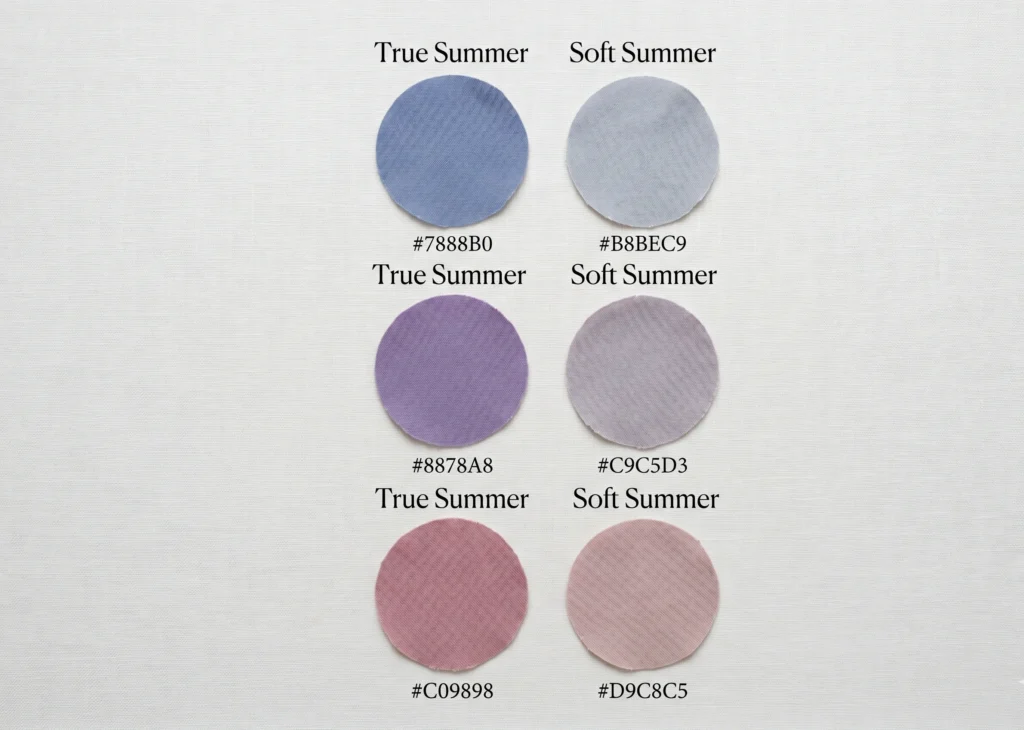
The most direct way to see the True Summer vs Soft Summer distinction: observe corresponding colours from each palette. The hue is the same. The saturation is different.
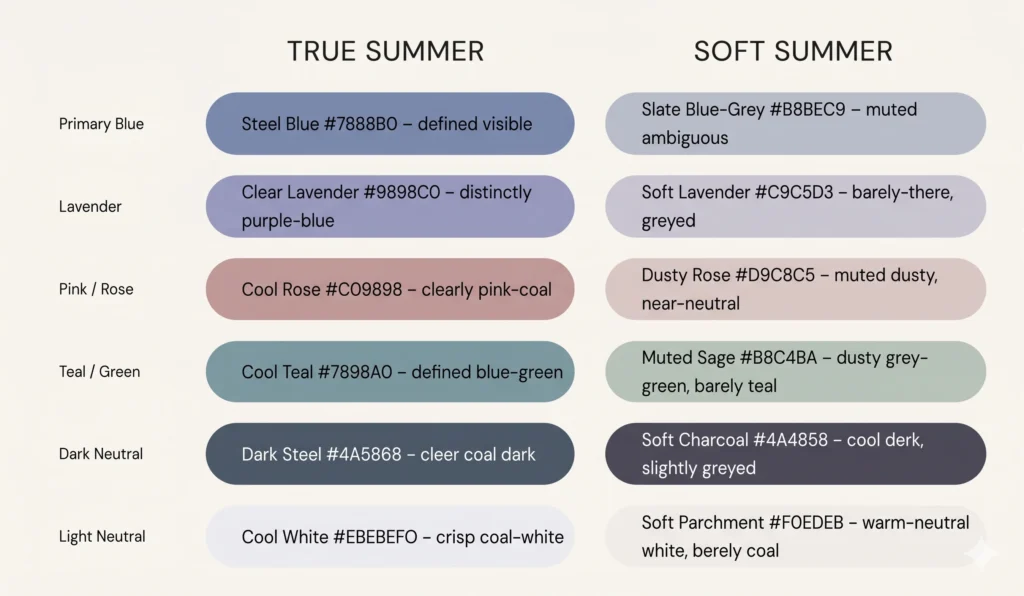
Notice the pattern: every Soft Summer colour is the True Summer version with grey mixed in. The hue is the same family. The grey modification changes everything — reducing chroma, softening clarity, and creating the blended, dusty quality that distinguishes Soft Summer from its crisper sibling.
The Chroma Comparison — Seeing the Difference
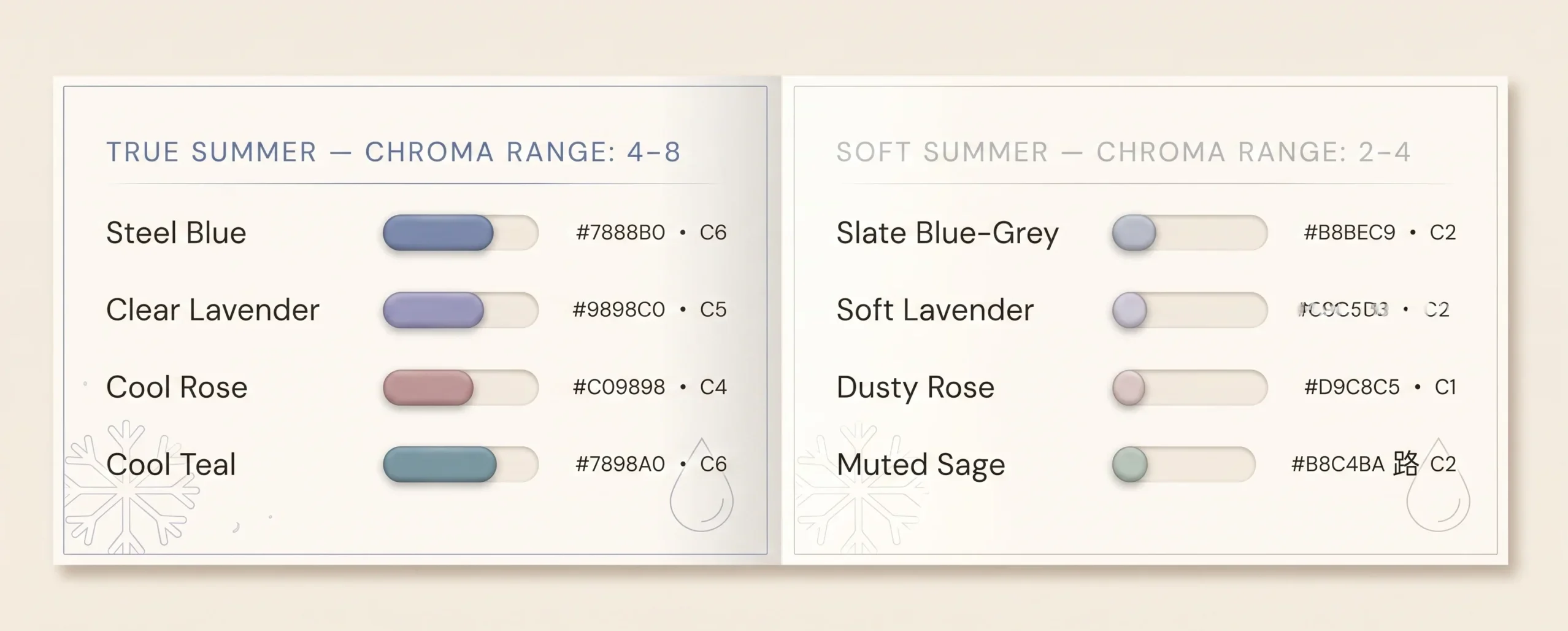
Chroma (saturation) is the most important number in the True Summer vs Soft Summer comparison. In the Munsell notation, Soft Summer colours typically sit at Chroma 2–4. True Summer colours typically sit at Chroma 4–8. The overlap zone (Chroma 3–5) is where some colours from each palette look similar — this is the boundary area.If you don’t understand chroma ,hue &value visit our guide on the Building blocks of color for clarity .
3 Diagnostic Tests to Tell Them Apart
The True Summer vs Soft Summer boundary is the most subtle in the Summer family. These three tests specifically target the saturation variable — the single dimension that separates the two seasons.
01
The Vivid Cool Blue Test — The Most Diagnostic
Natural daylight required · One vivid cool blue and one muted slate blue
Hold a clearly vivid, defined cool blue (like a medium cornflower blue or steel blue — Chroma 6–8) near your face in natural daylight. Then replace it with a muted, greyed-down slate blue (Chroma 2–3). Observe the skin carefully — not the fabric.
→ True Summer
The vivid cool blue looks natural and flattering — it matches the clarity of the features. The muted slate blue looks a little washed-out or flat by comparison. Your colouring can absorb a medium level of saturation.
The vivid cool blue slightly overwhelms the face — the colour reads as slightly more present than you are. The muted slate blue reads as more natural and harmonious. Your colouring needs the grey modifier to balance.
02
The Feature Clarity Test
Photograph yourself in natural light, no makeup or minimal makeup
Look at a natural-light photograph of yourself without makeup. Focus specifically on your eyes, hair, and the definition between your features. Ask: are the features clearly defined against each other — hair clearly darker than skin, eyes clearly a distinct colour? Or do they blend and merge, making it hard to see where one element ends and another begins?
→ True Summer
Features have visible definition. Hair is noticeably darker than skin with a clear separation. Eyes are a distinct, readable colour. There is a moderate contrast between elements — not stark, but visible.
→ Soft Summer
Features blend into each other. Hair and skin sit in similar depth ranges. Eyes carry a grey quality that makes them hard to name precisely. The overall impression is of gentle blending rather than clear definition.
03
The Naming Ambiguity Test
Ask someone to describe your hair, skin, and eye colour in one word each
Ask someone who has not thought about colour analysis to describe your natural hair, skin, and eye colour using one word each. Do they name them clearly and immediately? Or do they hesitate and use compound terms like “grey-brown,” “blue-grey,” or “golden but not really”?
→ True Summer
Clear single-word descriptions come quickly: “brown hair,” “blue eyes,” “pale skin.” Each feature is identifiable on its own. There is enough saturation in each element to give it a clearly nameable quality.
→ Soft Summer
Hesitation and compound terms: “sort of brown but ashy?” “blue but kind of grey?” “pale but pinkish-neutral?” The muted quality of the features resists clean categorisation. Naming ambiguity is a Soft Summer signal.
Feature Comparison — Hair, Skin, and Eyes
Physical features often — but not always — reflect the season’s saturation level. True Summer features tend toward slightly more visible colour definition. Soft Summer features tend toward the blended, muted, ashy end of the same cool spectrum.
|
Feature |
True Summer |
Soft Summer |
|
Hair |
Medium-to-dark cool brown, occasionally ash-medium blonde. Clearly defined colour — reads as noticeably darker than skin. Ash quality present but the brown is readable. |
Light-to-medium ash brown, mushroom, cool taupe-brown. Ambiguous depth — hair and skin sit in similar value range. The hair’s muted, ashy quality makes it hard to classify quickly. |
|
Skin |
Cool-neutral to cool with a visible and consistent blue-pink undertone. Porcelain to medium. The cool quality of the skin reads as clear rather than foggy. |
Light-to-medium ash brown, mushroom, cool taupe-brown. Ambiguous depth — hair and skin sit in similar value range. The hair’s muted, ashy quality makes it hard to classify quickly. |
|
Hair |
Medium-to-dark cool brown, occasionally ash-medium blonde. Clearly defined colour — reads as noticeably darker than skin. Ash quality present but the brown is readable. |
Cool-neutral to cool with a slightly smoky or ashy quality. May look slightly “washed” in photographs without the right palette. The cool undertone is present but blended into a grey-muted quality. |
|
Eyes |
Blue, blue-grey, or blue-green with visible clarity. The eye colour is readily identifiable as a distinct cool tone. Moderate contrast between iris and white. |
Grey-blue, grey-green, grey-hazel, or muted cool-brown. The grey overlay is dominant — the eye colour is difficult to name with certainty. Changes apparent colour significantly with clothing choices. |
|
Overall Contrast |
Medium contrast — hair is visibly darker than skin, eyes are a distinct cool tone. A colour analyst would describe the contrast as noticeable but not dramatic. |
Low-to-medium contrast — features blend together. In a black-and-white photo, hair, skin, and eyes would all sit in a close mid-range without dramatic differences between them. |
Practitioner’s Note — Why Features Aren’t Always Definitive
“In studio practice, I have seen many True Summers with physically muted features and Soft Summers with slightly more defined colouring. Physical feature description is a starting point, not a conclusion. The drapting test — specifically the vivid cool blue vs muted slate blue test — is always more reliable than describing features alone. The season lives in the colouring’s response to saturation, not strictly in the feature description.” Check our complete guide on soft summer browns .
Celebrity Examples — Who Belongs Where
Observing how established examples wear their respective palettes clarifies the saturation distinction better than any technical description.
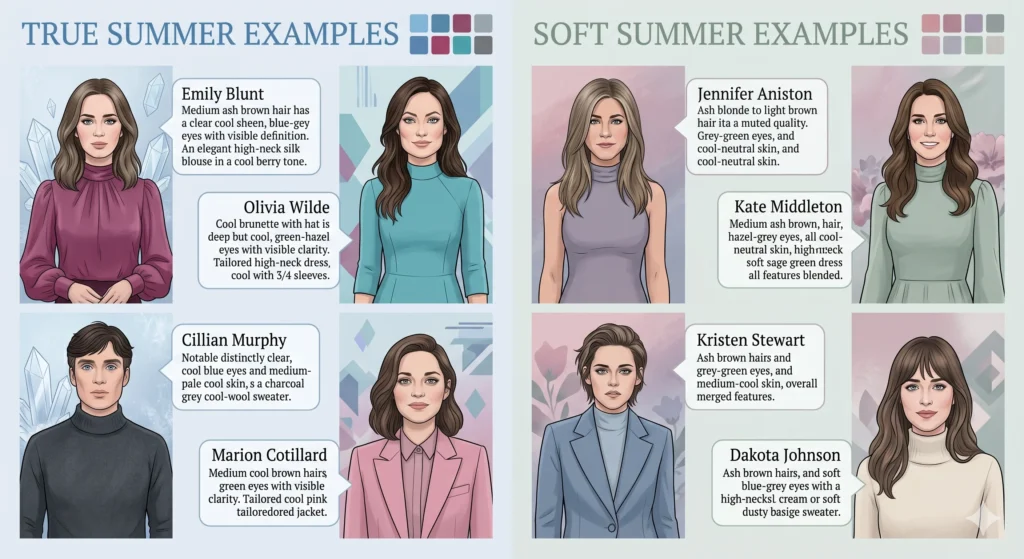
Notice the pattern: True Summer celebrities tend to be described in clearer terms (“blue eyes,” “brown hair”) while Soft Summer celebrities are described in compound, ambiguous terms (“grey-green,” “ash-brown,” “mushroom”). The naming ambiguity in the celebrity description is itself a season signal. You might want to take our soft summer quiz to know about your standing .
Is True Summer the Same as Cool Summer?
This is a genuine and common question. The answer depends on which colour analysis framework is being referenced.
|
Framework |
What “Cool Summer” Means |
Relationship to True Summer |
|
12-Season System |
Cool Summer IS True Summer — the exact same season with an alternate name |
Identical — same palette, same characteristics |
|
16-Season System (Sci/ART) |
True Summer is one of four Summer sub-seasons. “Cool Summer” is sometimes used informally as a synonym. |
Effectively the same season in most contexts |
|
Some practitioners’ usage |
“Cool Summer” as an umbrella term for the entire Summer family (all four sub-seasons) |
Different usage — here “Cool Summer” means all Summers, not just True Summer |
The safe answer: True Summer = Cool Summer in nearly all practical colour analysis contexts. If a source refers to “Cool Summer” as a distinct palette, it is describing the same colouring as True Summer — clear, cool, medium saturation. Soft Summer is the muted variant of the same family.
What Happens When You Wear the Wrong One
The error is visible but subtle — much less dramatic than a Soft Summer wearing warm autumn tones or a True Summer wearing Bright Winter colours. The True Summer/Soft Summer error is a saturation mismatch within the same cool family.
|
Scenario |
What Happens Visually |
The Effect |
|
Soft Summer wearing True Summer colours |
The clothing is slightly more vivid than the face can absorb. The colours are cool (correct temperature) but too clear (excess saturation). |
The clothing reads as slightly more present than the face. Features look softer and slightly flatter by contrast with the clearer colours. |
|
True Summer wearing Soft Summer colours |
The clothing is slightly too muted and greyed to match the face’s natural clarity. The colours are cool (correct temperature) but too blended. |
The clothing reads as slightly washed-out rather than activating the features. The face’s natural clarity is not matched by the palette’s saturation. |
Neither error creates the jarring, sallow, or draining effect that a warm-cool thermal mismatch creates. The saturation error within the Summer family is a subtlety error — it reduces the harmony but does not create obvious conflict. This is why many people wear both palettes interchangeably without identifying the difference.
True Summer vs Soft Summer at Every Skin Depth
Both seasons occur across all Fitzpatrick depths. The saturation distinction applies regardless of depth — the chroma of the correct palette responds to the colouring’s biology, not its depth level.
|
Skin Depth |
True Summer Indicators |
Soft Summer Indicators |
|
Cool-Fair (I–II) |
Visible colour definition in eyes and hair. Cool pink undertone is clear. Hair-skin contrast is noticeable. |
Features blend together. Ashy, slightly smoky quality to skin. Hair and skin in similar depth range. Naming ambiguity in feature description. |
|
Cool-Light (II–III) |
Cool undertone reads clearly. Eye colour has visible definition and named quality. Medium contrast between hair and skin. |
Cool undertone present but with a greyed, smoky overlay. Eye colour has grey modifier. Low contrast between features. “Mushroom” quality to skin and hair. |
|
Cool-Medium (III–IV) |
Ashy or cool-neutral undertone with visible clarity. Features have defined contrast — skin and hair clearly different in depth. |
Cool-ashy undertone with blended quality. Hair and skin depth are closer together. Features read as unified rather than contrasted. |
|
Cool-Deep (V–VI) |
Blue-cool undertone with clear, defined quality. Deep skin has a visible cool quality without the smoky ambiguity. Features read as distinctly themselves. |
Blue-cool undertone with a smoky, muted overlay. Deep skin has a more blended quality. Medium-value hair sits closer to the skin’s relative depth than in True Summer. |
True Summer vs Soft Summer — FAQs
What is the difference between True Summer and Soft Summer?
One word: saturation. Both are cool-toned and part of the Summer family. True Summer has slightly higher saturation — colours are clearer and more defined. Soft Summer has significantly lower saturation — colours are muted, greyed, and blended. True Summer colours are immediately nameable as a specific hue. Soft Summer colours resist easy naming — they feel ambiguous, somewhere between two descriptions. Both avoid warm tones, but their saturation tolerance differs significantly.
Is True Summer the same as Cool Summer?
In most colour analysis frameworks, yes. In the 12-season system, Cool Summer and True Summer are the same season with different names. In the 16-season Sci/ART framework, True Summer is the most specific term for the clear, cool, medium-saturation Summer sub-season. Soft Summer is always a distinct, separate season — the muted version of the Summer family — regardless of naming conventions.
What happens if a Soft Summer wears True Summer colours?
True Summer colours are cool in temperature (correct for Soft Summer’s undertone) but slightly more vivid in saturation than the Soft Summer chroma range accommodates. The result: the clothing reads as slightly more present than the face. The features look softened and slightly flatter by comparison with the clearer colours. The effect is subtle — much less obvious than wearing warm colours — but visible in natural light, particularly in photographs.
How do I know if I’m True Summer or Soft Summer?
Use the vivid cool blue test: hold a clearly defined, medium-saturation cool blue near your face in natural daylight. If it looks natural and your features look defined beside it — True Summer. If it slightly overwhelms and a muted grey-blue looks more harmonious — Soft Summer. Complement with the feature clarity test: if others describe your features in single clear words, True Summer. If they use compound or ambiguous descriptions, Soft Summer.
Is Soft Summer more muted than True Summer?
Yes — significantly more muted. Soft Summer palette colours typically sit at Munsell Chroma 2–4. True Summer palette colours typically sit at Chroma 4–8. This means the same hue at Soft Summer’s saturation level is roughly half as vivid as at True Summer’s saturation level. The difference is visible in direct comparison but easy to overlook when looking at each palette in isolation.
What is the difference between Soft Summer and True Summer celebrities?
True Summer celebrities (e.g., Emily Blunt, Marion Cotillard, Olivia Wilde) typically have slightly more contrast in their colouring — darker hair against lighter skin, with a clearer cool quality to features rather than the blended, muted quality of Soft Summer. Soft Summer celebrities have a more blended, greyed, low-contrast appearance — the features all sit in a similar depth range and no single element creates dramatic contrast against the others. True Summer is crisp overcast sea — Soft Summer is hazy August fog.
Your Decision Framework
True Summer or Soft Summer — Your 4-Step Decision
If you have narrowed your season to the True Summer / Soft Summer boundary, use this four-step sequence to resolve it:
- Run the vivid cool blue drape test: Vivid cornflower blue near the face in natural light. Does it look natural and flattering (True Summer) or slightly overwhelming (Soft Summer)? This single test is more diagnostic than any other step.
- Check your feature description: Can someone describe each feature in one clear word, or do they need compound terms? Clear naming = True Summer direction. Naming ambiguity = Soft Summer direction.
- Review your wardrobe history: Which clothes have consistently received the most “you look great today” comments? If they are clear, defined cool colours — True Summer. If they are muted, dusty, slightly greyed cool colours — Soft Summer.
- Compare to the celebrity examples: Whose colouring — Emily Blunt or Jennifer Aniston, Cillian Murphy or Kristen Stewart — reads as closest to yours in natural, unfiltered photographs? The clear-defined group is True Summer. The blended-muted group is Soft Summer.
For the full Soft Summer palette, wardrobe, and makeup guides — see the complete Soft Summer resource library on this site.