True Summer Jewelry Guide: Gold vs Silver & Best Metals
True Summer Jewelry & Metals The Cool Summer Guide to Gold, Silver & Gemstones
Quick Answer
True Summer is the alternate name for Cool Summer, so True Summer jewelry follows the Cool Summer metal rule — light-to-medium, cool-toned silver. Sterling silver, white gold, platinum, and rhodium sit at the top. Yellow gold and warm brass sit at the bottom. Icy rose gold and antique silver work as accents, not everyday staples.
The True Summer Box
A visual breakdown of the True Summer jewelry hierarchy: cool, fluid silver claims the absolute center, soft gemstones play supporting roles, and warm gold is strictly pushed to the periphery.
True Summer isn’t a separate rulebook. It’s a naming choice for the same cool, medium-value, softly muted season another system calls Cool Summer. Settle that first, and the metal question gets simple fast.
Is True Summer Jewelry the Same as Cool Summer Jewelry?
In the twelve-season framework, yes — True Summer is Cool Summer, just named by a different school. Both point at the same archetype: cool undertone, medium value, soft rather than saturated chroma.
A few sixteen-season systems do split the two: Cool Summer leans a touch icier toward Winter; True Summer sits at the balanced centre. For jewelry it barely moves the needle — both stay inside the same light-to-medium, cool-metal family, with Cool Summer simply reaching for slightly brighter polish. If your analysis used either word, nothing below changes.
Not the same as True Winter. Both run fully cool, but Winter wants mirror-bright silver to match its high contrast. True Summer wants that same coolness with the volume turned down — brushed, not blazing.
Why Metal Undertone Matters More Than Metal Price
Metal reflects its own colour onto the skin next to it, the way a coloured lampshade tints a room. Yellow gold throws warm, golden light that fights a cool undertone and often reads sallow, however expensive the piece. Silver, white gold, and platinum throw a cooler, whiter light that sits flush with that same skin instead.
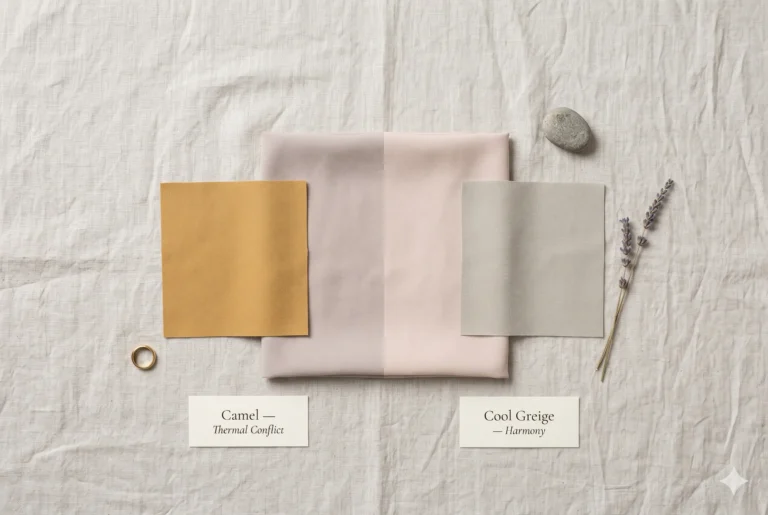
The whole mechanism, in two swatches.
Cool white-blue light (silver) sits flush against a cool undertone. Warm ember light (gold) fights it.
This is a contrast-and-undertone problem, not a budget one. A ten-dollar sterling silver chain reads cleaner on True Summer colouring than a solid-gold necklace worth a hundred times more — the metal’s temperature is doing the work, not its price tag.
The True Summer Metal Compatibility Chart
Six metal categories, ranked the way an in-person draping session would rank them:
Every “best” metal sits in a tight cool band. Yellow gold sits noticeably outside it — exactly what a draping session is checking for.
Can a True Summer Wear Gold Jewelry?
Yes — in small, strategic doses. A full head-to-toe yellow gold look is the one to skip, not gold as a metal altogether. A thin ring, a gold clasp inside a mostly-silver stack, or one warm accent bead rarely causes the clash a solid gold necklace does — distance from the face and proportion matter more than the metal itself.
In practice, this is the compromise most True Summers actually land on: keep a loved gold piece — a wedding band, an heirloom — and let everything else stay cooler, so the gold reads as one accent instead of the whole story.
What About Rose Gold?
True Summer often carries a naturally rosy skin quality, so an icy rose gold can work where a warm, copper-heavy one won’t. Hold the piece next to plain silver: still pink, it’s safe; reading orange or brown, treat it like yellow gold.
Icy Rose Gold (#D8B7B3) — yes.
Copper Rose Gold (#B8794F) — treat like yellow gold.
Cool Summer Gold or Silver — Run the Metal Drape Test
No professional draping session required — analysts run a simplified version of this test on themselves between appointments. It works just as well at your own mirror.
Gather two small squares — one silver fabric or foil, one gold — and find natural daylight. A window beats any indoor bulb, warm bulbs especially.
Hold the silver square under your jaw. Watch your skin, not the fabric. Brighter, smoother, more awake?
Switch to gold in the same spot. Does your skin look a little grey, a little tired?
Compare the shift. That change is the whole test.
Silver wins clearly → cool metals are yours. Gold wins clearly → warmth suits you better than this guide does. Neither does much → contrast is the bigger factor, and a professional draping session will settle it faster than repeating the foil test.
Gemstones That Belong in a True Summer Jewelry Box
Metal sets the temperature. Gemstones fill in the rest — and this palette has more range than its “just wear silver” reputation suggests.
The season’s clearest, most watery cool.
Soft powder-blue, never electric.
Light-to-medium only — skip laser-bright cuts.
Closer to orchid in low light than neon violet.
Amethyst’s moodier, deeper cousin.
Icy pink, not peachy — check against white paper.
Cool sheen only — skip cream or golden strands.
True Summer Jewelry Across Every Skin Depth
True Summer is defined by undertone, value, and chroma — not by how light or deep the skin is. The metal rule holds at every point on that range, because cool wins over warm due to undertone, not contrast.
Illustrative range — undertone stays cool throughout, regardless of depth.
Depth changes how the metal reads, not whether it works. On fair-cool skin, brushed silver sits close in value to the skin — soft, blended. On deeper-cool skin, polished platinum or white gold create more contrast, which reads as clean definition instead.
This is the question I hear most in consultations: does the metal rule change with skin tone? It doesn’t — only how loudly the contrast shows up. A warmer, golden undertone, however fair the skin, will always suit gold better than this palette does; depth tells you how much contrast to look for, undertone tells you which metal family to start with.
True Summer vs. Soft Summer vs. Cool Winter Jewelry
Five pieces cover almost every outfit this season needs to solve for:
Start with the first two. Everything else fills in around them.
FAQ: True Summer Jewelry Answered
Is True Summer jewelry the same as Cool Summer jewelry?
Yes. True Summer and Cool Summer are two names for the same seasonal colour-analysis type in the twelve-season system. The jewelry guidance — cool, light-to-medium metals over warm gold — applies equally whichever name your analysis used.
Can a True Summer wear gold jewelry?
In small amounts, yes. A thin ring, a clasp, or a single accent bead rarely causes a clash. A solid gold piece worn close to the face, in quantity, is the version to avoid.
What is the best jewelry metal for True Summer?
Sterling silver, white gold, and platinum in brushed or polished finishes are the most reliable choices. They mirror the cool undertone that defines this season without any adjustment needed.
Can True Summer wear rose gold?
Yes, if the rose gold leans icy and pink rather than warm and copper. Hold it beside plain silver — if it still reads pink, it works. If it reads orange or brown, treat it like yellow gold.
What gemstones suit a True Summer colour palette?
Aquamarine, amethyst, tanzanite, rose quartz, morganite, and cool-toned pearls all sit inside this palette. Keep the saturation soft rather than electric, and avoid warm stones like citrine, amber, or coral.
How is True Summer jewelry different from Soft Summer jewelry?
Both avoid warm gold, but Soft Summer favours a more muted, antique silver finish, while True Summer wears the same cool metals with more clarity and a brighter, cleaner polish.
Should True Summer jewelry be shiny or matte?
Somewhere in between. True Summer’s medium contrast suits a brushed, satin, or softly polished finish better than either a dull matte surface or True Winter’s mirror-bright shine.
Where to Go From Here
Start with the metal drape test above — it takes two minutes and settles the gold-or-silver question faster than any amount of scrolling. Once you know your metal family, the gemstones, finishes, and capsule list all fall into place around it.
I’ve watched one foil test under a plain window settle more “gold or silver” arguments than any product recommendation ever has — run it before your next jewelry purchase, not after.
Colour analysis is a styling tool, not a diagnosis or a rulebook — treat every guideline here as a starting point to test against your own reflection, not a requirement.